
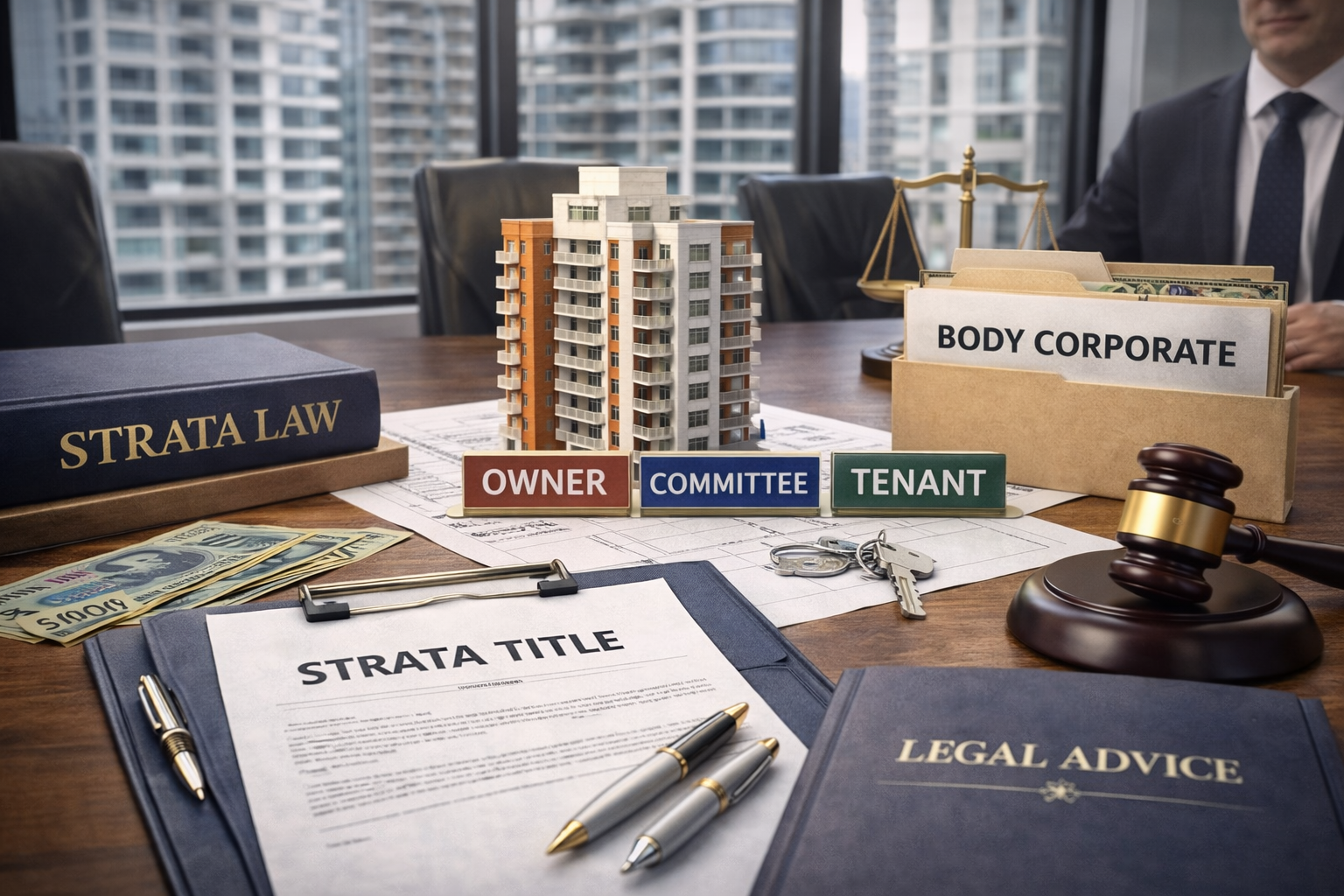
At a Glance
- Strata title allows for individual ownership of a "lot" while sharing ownership of common areas.
- Owners Corporations are legal entities responsible for the management and upkeep of the scheme.
- By-laws govern everything from pet ownership to renovations and noise levels.
- Compulsory levies are required to fund the maintenance of the building and its facilities.
- Disputes are typically resolved through state-based tribunals like NCAT or VCAT.
Understanding the Strata Concept
Strata title was pioneered in New South Wales in the 1960s and has since become the global standard for multi-level apartment ownership. Unlike traditional "Torrens Title," where you own the land and the structure, strata title divides a property into "lots" and "common property."
When you purchase a strata lot, you legally own the space identified as your “Lot” in the registered strata plan, with the exact boundaries determined by that plan; areas such as the roof, external walls, stairwells, and gardens are generally classified as common property, but you share the ownership of the roof, the stairwells, the gardens, and the external walls with every other owner in the scheme. This collective ownership is managed through an Owners Corporation (or Body Corporate), which functions like a mini-government for the building.
The Legal Weight of By-laws
By-laws are the rules that govern the daily life of the strata scheme. They are not merely suggestions; they are legally enforceable regulations. While many schemes adopt "model by-laws" provided by state legislation, an Owners Corporation can create its own specific rules.
Common legal triggers involving by-laws include:
- Short-term letting: Many schemes now implement strict rules regarding Airbnb-style rentals.
- Renovations: Owners often mistakenly believe they can renovate their kitchen or bathroom without permission, but any work affecting common property (like plumbing or floor waterproofing) usually requires formal approval.
- Pets: Recent landmark cases, such as Cooper v The Owners – Strata Plan No 58068, have shifted the legal landscape, establishing that blanket prohibitions on pets are generally invalid. However, an Owners Corporation may still impose reasonable and non-oppressive by-laws regulating pet ownership, and may take enforcement action where a pet causes actual nuisance, interference, or damage.
Financial Obligations: The Levy System
The legal obligation to pay levies is perhaps the most significant responsibility of a strata owner. These funds are divided into an Administrative Fund for day-to-day expenses (insurance, cleaning, electricity) and a Capital Works Fund (or Sinking Fund) for long-term repairs like roof replacements or painting.
Failure to pay levies can lead to severe legal consequences. Owners Corporations have the statutory power to charge interest on overdue amounts and in extreme cases, an Owners Corporation may enforce a court or tribunal judgment through formal enforcement proceedings, which can ultimately result in the sale of the lot to satisfy the outstanding debt.
Practical Case Example: The "Common Property" Trap
In the notable case of The Owners – Strata Plan No 50276 v Thoo, the court examined the duty of an Owners Corporation to maintain and repair common property. A lot owner claimed damages because the Owners Corporation failed to fix a recurring leak that damaged their property.
The case highlighted a critical legal principle: while the Owners Corporation has a strict duty to maintain common property under legislation (such as Section 106 of the Strata Schemes Management Act 2015 in NSW), lot owners must follow specific legal procedures to compel these repairs. For owners, this means that if a building defect or lack of maintenance causes you loss, the law provides a pathway for recourse, but it requires diligent evidence and often tribunal intervention.
A Lawyer’s Perspective: What Often Goes Wrong
Most strata litigation arises from a misunderstanding of where a private lot ends and common property begins. We frequently see disputes where an owner installs an air-conditioning unit on an external wall, thinking it is "their" wall, only to be served with a notice to remove it because the external facade belongs to the Owners Corporation.
Another common point of failure is the "informal agreement." A chairperson might tell you over a coffee that you can park your boat in the visitor spot, but without a formal resolution or a change in by-laws, that agreement is legally worthless and can be revoked the moment a new committee is elected.
Key Takeaways
- You own your unit, but you share the building's skeleton and skin.
- By-laws are legally binding and can restrict how you use your property.
- Levies are mandatory, and non-payment carries heavy legal penalties.
- The Owners Corporation is legally obligated to maintain common property.
- Always check the strata records (a "strata search") before purchasing to identify hidden legal or financial issues.
Frequently Asked Questions
Who is responsible if my ceiling leaks from the unit above?
Generally, the Owners Corporation is responsible if the leak originates from a common property pipe or a failure in the structural floor slab. If the leak is caused by the upstairs neighbor’s poorly installed shower tray, it may be a private matter between owners.
Can the strata committee ban me from keeping a pet?
In most Australian jurisdictions, particularly after recent court rulings, blanket bans on pets are increasingly difficult to enforce. However, they can still set reasonable conditions regarding noise, hygiene, and the use of common areas.
What happens if I want to renovate my apartment?
Cosmetic changes like painting usually don't need approval. However, "minor renovations" (like floorboards) and "major renovations" (like moving walls) require an ordinary or special resolution from the Owners Corporation.
Do I have a say in how the building is run?
Yes. As a lot owner, you are a member of the Owners Corporation. You have the right to vote at General Meetings and can stand for election to the Strata Committee to take a direct role in decision-making.
Can I be fined for breaking a by-law?
Yes. If you breach a by-law, the Owners Corporation can issue a formal notice to comply. If the behavior continues, they can apply to a tribunal (like NCAT) to impose financial penalties.
How We Can Help
Navigating strata law requires a balance of technical knowledge and diplomatic resolution. We provide a range of services including:
- Reviewing and drafting bespoke by-laws for your scheme.
- Advising on disputes regarding common property maintenance and repairs.
- Representing owners or committees in tribunal proceedings (NCAT/VCAT).
- Assisting with the recovery of unpaid strata levies.
- Conducting thorough strata record inspections for prospective buyers.
Whether you are a lot owner facing an unfair fine or a committee member dealing with a difficult repair issue, we offer practical legal strategies to resolve your strata concerns efficiently.