
At a Glance
- Sponsorship is a legal undertaking to provide for a relative’s essential needs
- Different visa subclasses carry varying durations of support obligations
- Sponsors must meet specific income and character requirements
- An "Assurance of Support" (AoS) may be required as a financial bond
- Non-compliance can result in debts to the Commonwealth and future bans
The Core Concept of Sponsorship
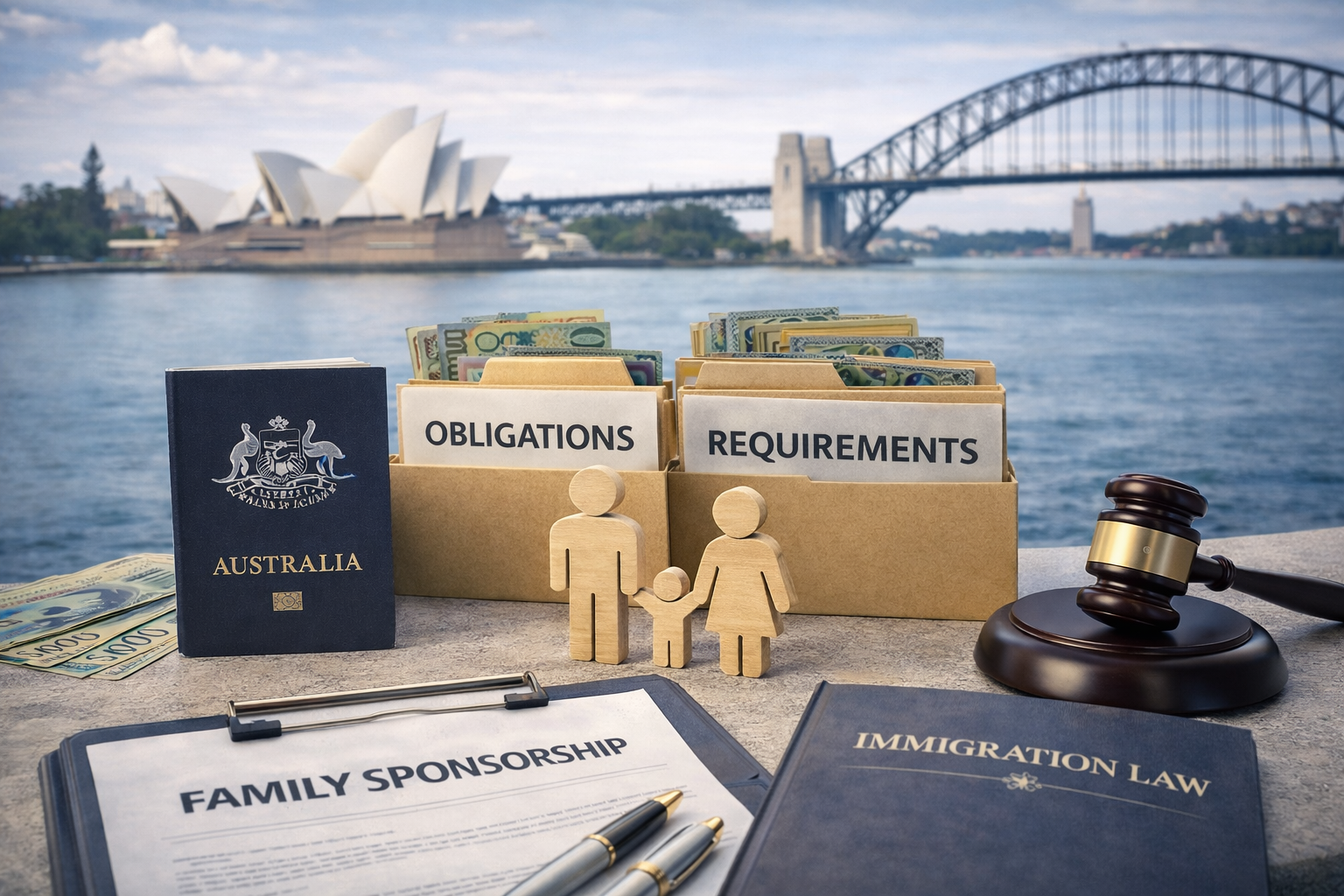
Under the Migration Act 1958 (Cth) and associated Regulations, sponsorship is not merely a gesture of support; it is a legally binding agreement between the sponsor and the Australian Government. For many family visas, sponsors undertake to provide accommodation and financial support to the visa holder for a defined period following visa grant, often two years. The precise obligations vary according to the visa subclass and are governed by the relevant sponsorship undertaking and applicable statutory and regulatory requirements.
The primary objective of these laws is to ensure that new migrants are supported by their families rather than becoming a burden on the Australian taxpayer and the social security system.
Key Sponsorship Requirements
To be eligible to sponsor a family member (such as a partner, parent, or child), the sponsor generally must:
- Be an Eligible Person: Usually an Australian citizen, permanent resident, or eligible New Zealand citizen.
- Meet the Age Requirement: Most sponsorship categories require the sponsor to be at least 18 years old.
- Pass Character Tests: Sponsors for partner and child visas must provide police clearances. If a sponsor has a "significant criminal record" involving certain offences (particularly those involving children or violence), the sponsorship may be refused.
- Demonstrate Financial Capacity: While not all visas have a strict income threshold, the sponsor must show they can realistically support the applicant.
Specific Obligations: What are you agreeing to?
Once the visa is granted, the sponsor’s obligations become active. These typically include:
- Financial Support: You must provide for the applicant's living costs so they do not need to apply for government benefits.
- Accommodation: You are responsible for ensuring the applicant has a place to live during their initial period in Australia.
- Settlement Assistance: This includes helping the relative attend English language classes or navigate the healthcare system.
In cases such as the Contributory Parent Visa, the obligation period can extend to 10 years, reflecting the higher potential costs associated with older migrants.
The "Assurance of Support" (AoS)
For many family visas, particularly parent visas, the Department of Home Affairs requires an Assurance of Support. This is a legal deed overseen by Centrelink.
The "Assuror" (who is often the sponsor) may be required to lodge a financial bond (bank guarantee) with the Commonwealth Bank. If the visa holder claims certain social security payments during the AoS period, the government will use the bond to recoup those costs. If the costs exceed the bond, the Assuror becomes liable for a debt to the Commonwealth.
Practical Case Example: The Cost of Breaching a Sponsorship Undertaking
In a representative scenario, a sponsor supported their parents’ migration to Australia under the Contributory Parent (Subclass 143) visa and, as required, provided a 10-year Assurance of Support (AoS).
By the fifth year of residence, the family relationship had broken down and the parents ceased living with the sponsor. Subsequently, due to financial hardship and while the AoS was still in effect, the parents began receiving recoverable social security payments. Despite the breakdown of the family relationship and the parties no longer living together, the Assurance of Support remained legally binding. Centrelink issued a debt notice to the sponsor, requiring repayment of the amounts paid to the parents during the AoS period. The sponsor’s liability to the Commonwealth was not extinguished by private disputes or separation, ultimately resulting in a substantial debt.
This example highlights a critical principle of Australian migration and social security law: sponsorship and Assurance of Support obligations are owed to the Commonwealth and generally operate independently of the private family relationship between the parties.
How Long Do Obligations Last?
The duration depends on the visa type:
- Partner Visas: Generally two years from the date the initial temporary visa is granted.
- Child Visas: Until the child reaches independence or a specific timeframe expires.
- Parent Visas: Between 2 and 10 years, depending on the specific subclass and whether an AoS is involved.
Key Takeaways
- Sponsorship is a binding contract with the Australian Government
- Sponsors are financially responsible for the migrant's first few years
- Criminal records can disqualify an individual from being a sponsor
- The Assurance of Support is a "debt-recovery" mechanism for the government
- Obligations usually continue even if family relationships break down
Frequently Asked Questions
Can I withdraw my sponsorship if we have a falling out?
You can notify the Department of Home Affairs that you wish to withdraw your sponsorship before a visa is granted. However, once the visa is granted, you generally cannot "cancel" your financial obligations for the duration of the agreed period.
Does my income need to be above a certain level?
For most partner visas, there is no fixed "dollar amount," but you must show you can support the applicant. For Parent visas involving an Assurance of Support, you must meet a specific income test calculated by Centrelink based on your family size.
Am I responsible for my relative's medical bills?
While you are responsible for their general support, permanent residents usually have access to Medicare. However, for temporary visa holders, you may be expected to ensure they hold adequate private health insurance.
What happens if I move overseas after sponsoring someone?
As a sponsor, you are generally expected to remain in Australia to provide the required support. Moving overseas may complicate your ability to meet your obligations and could impact the visa holder's status in certain circumstances.
Can I sponsor more than one person at a time?
Yes, but there are limits. For example, in partner sponsorship, you can generally only sponsor two people in your lifetime, and they must be at least five years apart, unless there are "compelling circumstances."
How We Can Help
Navigating the complexities of Australian migration law requires precision. We provide expert assistance in:
- Assessing sponsor eligibility and identifying potential character or financial risks;
- Preparing and lodging robust sponsorship applications;
- Advising on Assurance of Support (AoS) requirements and Centrelink income tests;
- Managing complex cases involving sponsorship bars or requests for waivers;
- Providing legal strategies when family relationships break down during the sponsorship period.
Our goal is to ensure both the sponsor and the applicant understand their rights and liabilities, preventing unexpected financial or legal burdens.