
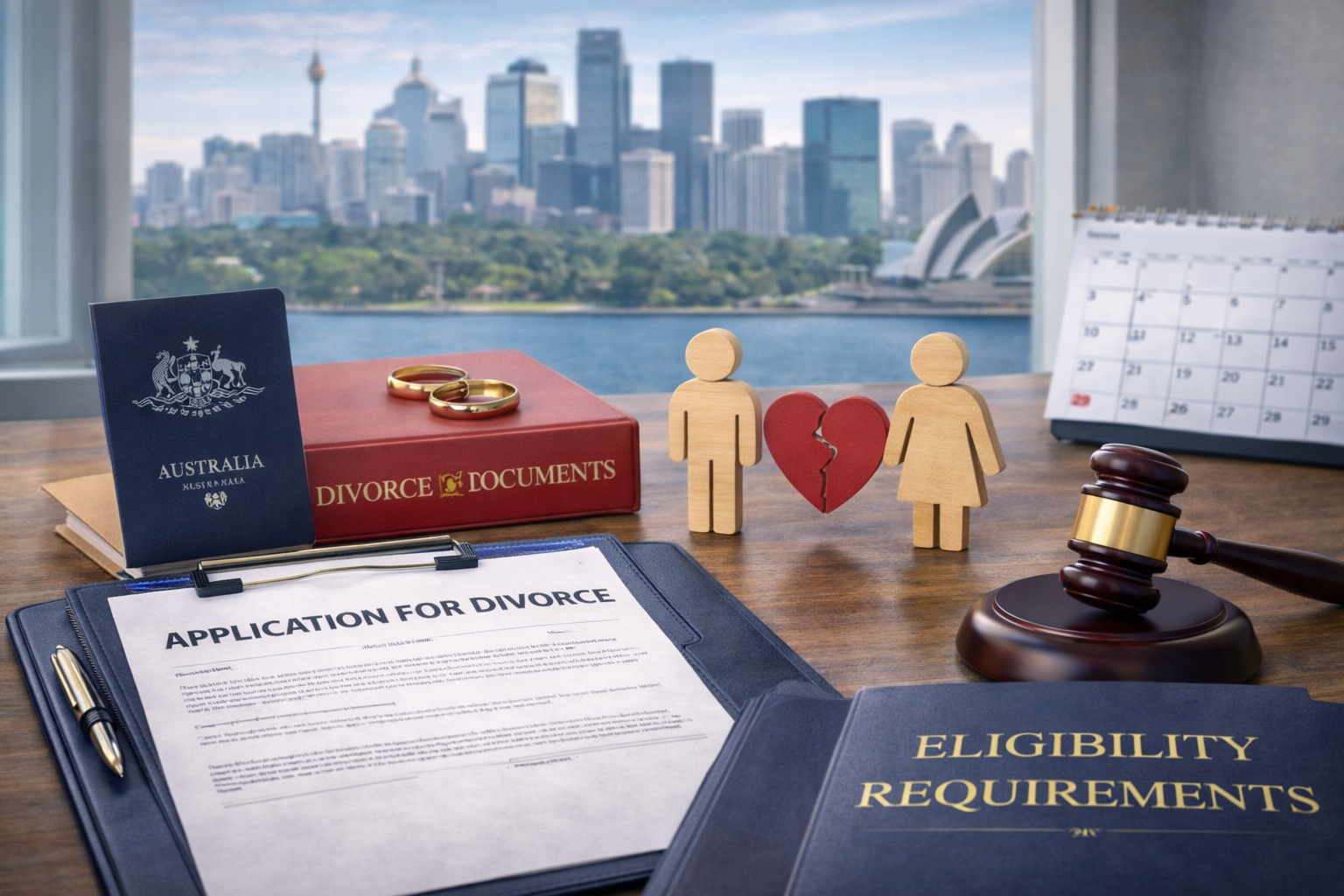
At a Glance
- Australia follows a "no-fault" divorce system under the Family Law Act 1975
- Couples must be separated for at least twelve months before applying
- You must prove the marriage has irretrievably broken down with no chance of reconciliation
- New Provisions Introduced in 2025 for Short-Term Marriages (Under Two Years)
- Divorce is a separate legal process from property settlement and parenting arrangements
The "No-Fault" Principle in Australian Law
In Australia, the legal system does not seek to assign blame for the end of a marriage. Under the Family Law Act 1975, the sole ground for divorce is the "irretrievable breakdown" of the marriage. This means the court is not interested in instances of infidelity or other conduct issues when deciding whether to grant the divorce itself.
To satisfy the court that the marriage has broken down irretrievably, parties must demonstrate that they have lived separately and apart for a continuous period of not less than twelve months immediately preceding the filing of the application, subject to s 50 of the Family Law Act 1975 (Cth), which permits periods of reconciliation of three months or less without restarting the twelve-month period.
Eligibility Requirements: Are You Eligible to Apply?
To apply for a divorce in the Federal Circuit and Family Court of Australia, at least one spouse must meet the following jurisdictional requirements:
- Regard Australia as their home and intend to live here indefinitely: or
- Be an Australian citizen by birth, descent, or grant of Australian citizenship: or
- Ordinarily live in Australia and have done so for the 12 months immediately before filing the application.
Furthermore, the court must be satisfied that proper arrangements have been made for the care, welfare, and development of any children of the marriage who are under the age of 18.
Separation While Living Under the One Roof
A common misconception is that separation requires living in different houses. In many cases, due to financial constraints or the needs of children, couples may remain in the same residence while being legally "separated." This is known as "separation under the one roof."
To prove this to the court, you will typically need to provide an affidavit outlining changes in the marriage, such as:
- Changes in sleeping arrangements:
- A reduction in shared activities or family outings:
- The separation of finances and bank accounts:
- How you have presented yourselves to family and friends.
In In the Marriage of Todd (No 2) and subsequently in Pavey & Pavey, the court confirmed that separation requires both the breakdown of the marital relationship (‘consortium vitae’) and the formation of an intention by at least one party to sever the marital union, communicated to the other party.
2025 Reforms for Short-Term Marriages (Under Two Years)
Historically (prior to the 2025 legal reforms), if you had been married for less than two years, the court required you to attend counselling with a family counsellor before filing for divorce, to explore the possibility of reconciliation. You were also required to submit a counselling certificate issued by the counsellor at the time of application. If counselling was not possible (for example, in cases involving family violence), you had to seek “leave of the court” by filing an affidavit explaining the circumstances. The two-year period was calculated from the date of marriage to the date of filing, not the date of separation.
However, the 2025 reforms abolished the counselling requirement for short-term marriages. Regardless of how long the marriage has lasted, you can now apply for divorce as long as you have been separated for at least 12 months and meet the other eligibility criteria. There is no longer any need to submit a counselling certificate or apply for leave of the court.
Practical Case Example: The Importance of the 12-Month Rule
Consider a case where a couple separated in January but briefly attempted to reconcile in March, living together for six weeks before separating again. Under Australian law, if the attempted reconciliation lasts for three months or less, the periods of separation before and after the reconciliation can be added together to satisfy the twelve-month requirement.
However, if they had lived together for four months during that attempt, the "clock" would have been reset, and they would have needed to start a new, continuous twelve-month period of separation before becoming eligible to apply for divorce. This highlights the strict statutory nature of timeframes in family law.
Key Takeaways
- You must be separated for a continuous period of at least 12 months immediately preceding the filing of the application (the Court requires 12 months to have elapsed before the application is filed; the divorce order becomes effective one month and one day after it is made).
- Separation "under one roof" is legally possible but requires additional evidence
- Irrespective of the duration of the marriage, parties may apply for divorce provided the separation and jurisdictional requirements are satisfied, without the need for a counselling certificate or leave of the court.
- A divorce order does not automatically resolve property or child custody matters
- You must serve the application on your spouse unless it is a joint application
Frequently Asked Questions
Do I have to prove why we are getting a divorce?
No. Australia is a "no-fault" jurisdiction, so you only need to prove that you have been separated for twelve months and the marriage has broken down.
Can I get a divorce if my spouse does not want one?
Yes. You can file a "sole application." As long as you meet the eligibility criteria and properly serve the documents on your spouse, the court can grant the divorce.
How long does the divorce process take?
Usually, it takes several months from the time of filing to the final hearing, followed by one month and one day after the divorce order is made for it to take effect, unless the Court shortens that period.
Does a divorce settle my property division?
No. Divorce is the legal end of the marriage. You have 12 months from the date of your divorce being finalised to commence court proceedings for property settlement or spousal maintenance. After that period, leave of the Court is required.
What if I cannot find my spouse to serve them the papers?
You may apply to the court for "substituted service" or a "dispensation of service" if you can prove you have made all reasonable attempts to locate them.
How We Can Help
Navigating the end of a marriage is emotionally and legally complex. Our team can assist you by:
- Preparing and filing your Divorce Application accurately to avoid court delays:
- Providing expert affidavits for "separation under one roof" cases:
- Arranging for the legal service of documents on your spouse:
- Representing you at the divorce hearing if required:
- Advising on the critical time limits for property settlements that begin once your divorce is granted.
We aim to provide a dignified and efficient path forward, ensuring all legal requirements are met so you can focus on your future.